
Modern Mindfulness Retreat With Victor Shiryaev, and Shinzen Young
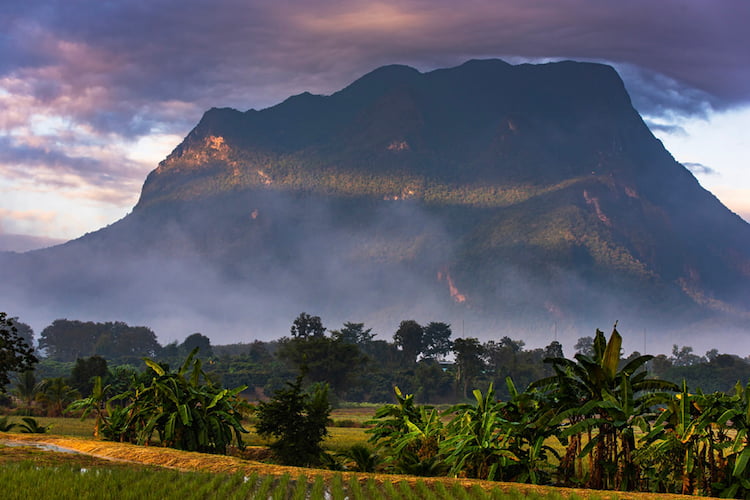
Kamin Springs Forest Retreat · Chiang Dao, Northern Thailand · January 2027
A residential silent retreat, taught in English, with a live video AMA with Shinzen Young.
Why do people go to a retreat? What do we retreat from — or to? Not from the busy world exactly, and not toward some special state, but from our habitual ways of thinking about and relating to ourselves and the world, and toward a more intimate look at what's actually here, with a clear, equanimous and caring mind.
Teaching from the mid-70s, Shinzen Young is a senior Western meditation teacher, whose approach is unusually clear and systematic. He breaks mindful awareness down into three attentional skills — concentration power, sensory clarity, and equanimity — trained by applying them to the three basic spaces of sensory experience: what we see, what we hear, and what we feel. The point isn't abstract: these skills, brought to bear on these spaces, serve what Shinzen calls the Three Jobs of a Human Being — to appreciate self and world, to go beyond self and world, and to improve self and world.

Victor is leading this retreat as Shinzen's student and as a teacher in his approach — he's studied with him since 2009, and taught full-time since 2013, including many silent retreats and a teacher training program in Russian since 2017.
Partway through the retreat, Shinzen will join us live by video call for an open AMA — a chance to ask questions directly of the person who built this entire system.
What this retreat is about
Ordinary life is full of distractions, parallel tasks, and habitual behavior. We rarely get to set aside real time to cultivate the positive qualities of body and mind — and that cultivation needs specific attentional skills, which are far easier to develop under the right conditions: day by day, in silence, with a full daily schedule of formal practice, clear meditation instructions, body-work sessions to help integrate the experience, and individual daily interviews to track and steer one's progress.
On retreat, participants learn to see clearly how they perceive and live through what happens to them — and to gently retrain that perception, and their relationship to themselves, for their own benefit and others'. This happens through careful, caring self-observation, in formal meditation and in every moment of the day.
People come to a retreat for various reasons: to rest, reset and recharge, to understand themselves better, to do spiritual work, to learn how to be with their thoughts and emotions, to find meaning, or to get to grips with the world.
Whatever your goal is, getting there tends to run through the same territory: stepping back, and using your attentional skills to return to yourself and look closely at how your own mind, perception, and reactions actually work. A retreat setting — quiet, structured, sustained — is good for that.
Individual interviews and daily body practice
Individual interviews, and body-based practice two times a day, are a critical part of this retreat — and of a trauma-informed approach to meditation more broadly.
Everyone's process is their own, and often not easy — understanding it, validating it, offering ways to work through it, and simply being present and available, is what makes a retreat actually work. If you're considering any retreat, it's worth checking whether it includes individual contact with an instructor, ideally daily.
The body also needs time and the right conditions — food, sleep, the presence of other people — to digest new information and integrate a new way of being. Deep body practice, beyond helping you sit with a straight spine without pain, exists for exactly this: we are bodily beings who experience ourselves and the world through the whole body, and every thought, insight, or realization is, at minimum, also a bodily process — so working with the body supports the rest of the work.
 The body practice on this retreat will be led by Maria Shiryaeva, Victor's wife. She is a certified mindfulness instructor in Shinzen Young's approach, and has done vipassana retreats in Nepal (Goenka and Mahasi traditions), as well as most of the retreats led by Victor. On the movement side, she is a yoga teacher in the Ashtanga and vinyasa flow traditions, trained in Mysore and Rishikesh (India) and in Pokhara (Nepal), and is RYT-500 certified through Yoga Alliance.
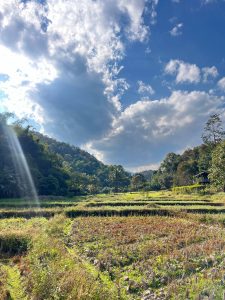
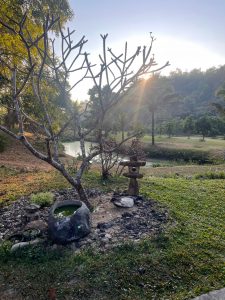
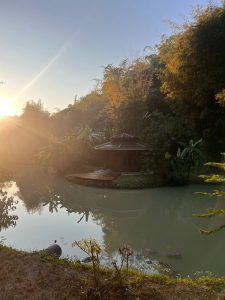
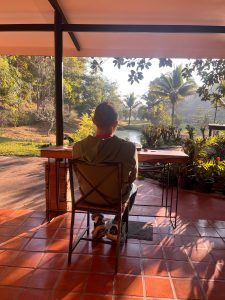
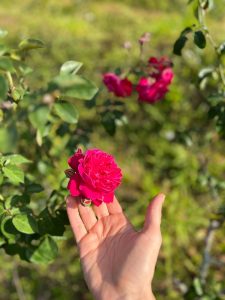
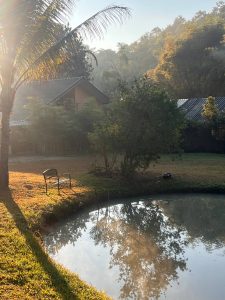
The venue: Kamin Springs Forest Retreat
The retreat will be held at Kamin Springs Forest Retreat, near Chiang Dao in northern Thailand — a place found by Shinzen Young's students to serve as an Asian hub for facilitating trainings in his approach.
It's a large property built around a fruit orchard and rice fields, set in a gorge hidden away from neighbors, where mornings arrive wrapped in fog. There are several ponds and a stream to sit by or to dip into, gazebos, a tea house, and a beautiful modern practice hall.
Kamin Springs is located on tribal territory, and facilitates retreats with the blessing of the tribal chief. The staff comes from the neighboring villages. Retreat participants will be served excellent, fresh, and organic Northern Thai food, sourced locally and catered to Western tastes.
Daily schedule
This is a tentative daily schedule that may change with participants' needs and the flow of the retreat.
Opening day
| Afternoon | Arrival & orientation |
| 6:00–7:15 pm | Dinner & rest |
| 7:15–8:45 | Sit & evening talk |
| 8:45 | Noble silence begins |
Full days
| 5:30 am | Wake-up |
| 6:00–6:30 | Silent sitting |
| 6:30–7:00 | Morning body practice |
| 7:00–7:30 | Silent sitting |
| 7:30 | Breakfast, free time |
| 9:00–9:30 | Introduction to the day's technique |
| 9:30–10:00 | Guided meditation on the new technique |
| 10:00–10:30 | Walking practice — individual interviews available |
| 10:30–11:00 | Sitting meditation |
| 11:00–11:30 | Walking practice — individual interviews available |
| 11:30–12:00 pm | Midday body practice |
| 12:00 | Lunch, free time |
| 2:30–3:00 | Walking practice |
| 3:00–3:30 | Sitting meditation |
| 3:30–4:00 | Walking practice |
| 4:00–4:45 | Q&A, sitting meditation (one evening: AMA with Shinzen) |
| 4:45–5:15 | Walking practice |
| 5:15–5:45 | Sitting meditation |
| 5:45 | Dinner |
| 6:45–7:45 | Evening talk, close of day |
Last day
| 5:30 am | Wake-up |
| 6:00–7:00 | Sit |
| 7:00–8:00 | Yoga |
| 8:00–9:00 | Breakfast |
| 9:00–12:00 pm | Wind-down |
| 12:00–1:00 | Light lunch, retreat ends |
Dates & travel
21 January: Gather in Chiang Mai; transfer to the retreat center (~1.5 hr by minivan). Evening: dinner, orientation, program begins.
22–28 January: Full retreat days.
29 January: Unwinding day; retreat ends. Optional evening transfer back to Chiang Mai.
We recommend arriving in Chiang Mai on 20 January, a day ahead — the 21st itself is taken up by transfer and orientation, so it's best not to be arriving into the country the same day. Similarly, since the 29th is a lighter unwinding day rather than a firm departure point, we recommend planning to leave Chiang Mai on 30 January rather than the 29th.
Fly into Chiang Mai (CNX) — an international airport, so your ticket may be direct or connect through Bangkok. From Chiang Mai, the group travels to and from the retreat center together by minivan.
Pricing
The total cost is the sum of two separate fees: a fixed teaching fee, and lodging & food, priced according to which accommodation you choose.
| Platform tent | $45/day — only 2 available |
| Main building, double occupancy | $65/day per person |
| Main building, single occupancy | $100/day |
| Private house (one person or a couple) | $165/day — only 1 available |
| Food (three meals/day) | $30/day |
Based on 8 nights at the retreat center (21–29 January), lodging + food ranges from $600 (tent) to $1,560 (private house).
Teaching fee (fixed): $900 per person — covers the retreat's teaching, guidance, and the AMA with Shinzen. A limited number of donation-based places may be available; get in touch to ask.
Total price, all-in: $1,625 – $2,585 per person, depending on your choice of accommodation.
The $1,025 teaching fee is an approximate dollar conversion of the previous retreat's rate — worth confirming against the exchange rate closer to booking.
It's possible to arrive earlier or stay later than the retreat dates — extra nights are billed at the same per-day lodging + food rate.
Practical information
Dates
21–29 January 2027 (arrive Chiang Mai by 20 Jan, depart 30 Jan)
Price
$1,625 – $2,585 per person, all-in (see Pricing above)
Group size
[limited to approx. X participants]
Who it's for
[prerequisites — TBD]
How to apply
[application link]
Not included
Flights; Chiang Mai ⇄ retreat center transfer ([$ per minivan]); optional sightseeing day costs